
 Blog
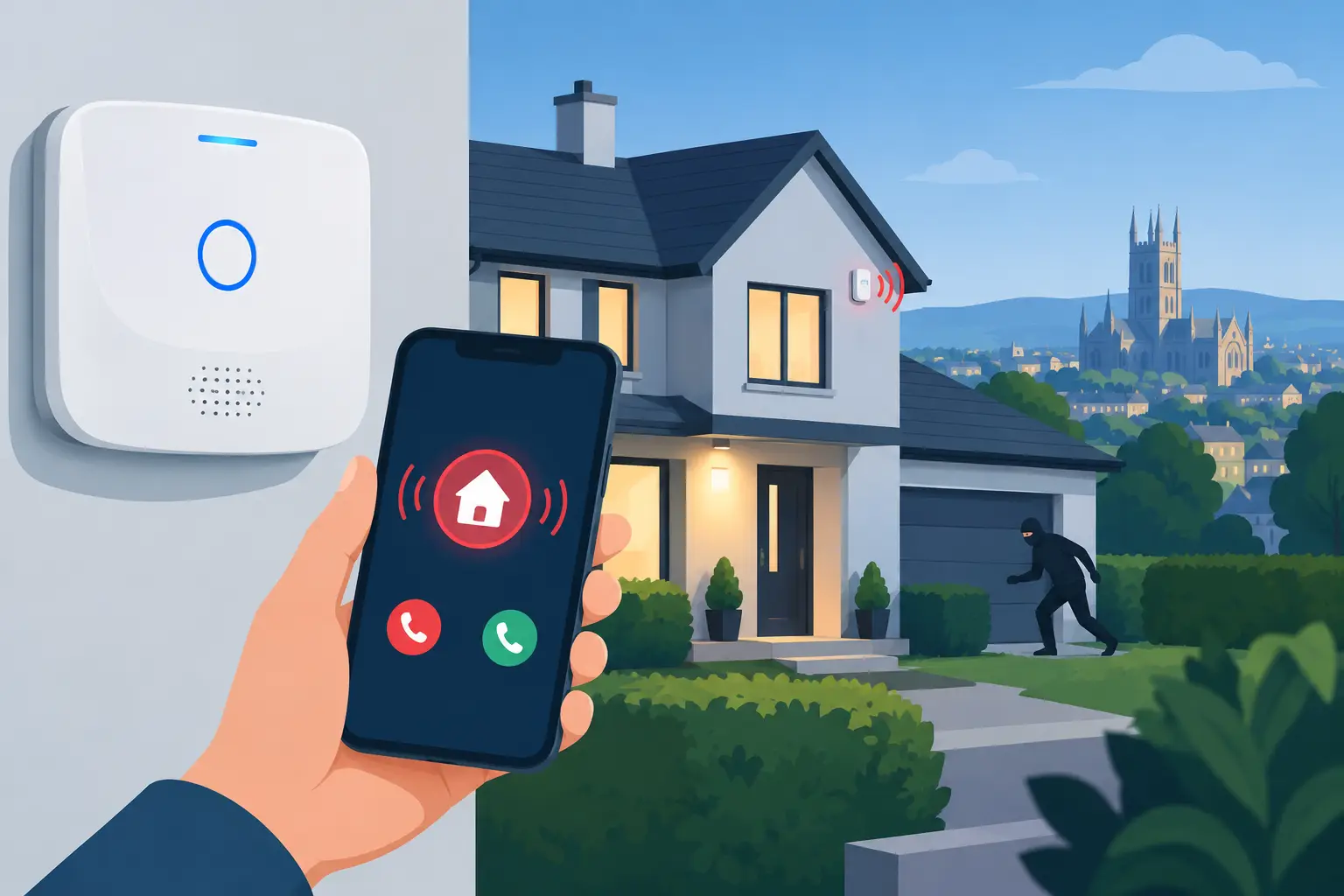
BlogA late-night alarm is only useful if the right person hears about it. Homeowners and business owners searching for systems that will call my mobile for my burglar alarm system in Cheltenham and Gloucestershire usually want a clear answer: yes, a professionally installed alarm can contact your cell phone when it detects an intrusion, tampering, fire, or another programmed event.
The best option is not always a basic phone dialer. The right system depends on the property, the risks involved, whether someone is normally available to respond, and how reliable you need the communication route to be. A properly designed alarm should give you fast information without creating a stream of nuisance alerts that people eventually ignore.
How burglar alarms call your mobile
Modern burglar alarms use a communicator connected to the alarm control panel. When a detector, door contact, panic button, or other device activates, the panel can send a signal over a cellular network, broadband connection, or both. Depending on the equipment and setup, that signal can trigger a voice call, an SMS text message, a mobile app notification, or a message to a professional alarm receiving center.
For people who specifically want a call, a voice dialer can be programmed with one or more contact numbers. The alarm panel calls those numbers in sequence and plays a recorded or system-generated message, such as an intrusion alert at the property. Some systems ask the recipient to acknowledge the call before moving on to the next contact.
This can be very useful for a family home, a small office, a shop, or a landlord managing an empty property. You can decide whether the call should go to you first, then a partner, family member, keyholder, manager, or trusted neighbor. The system should be programmed around who can act sensibly at the time, not simply who answers their phone fastest.
Mobile-call burglar alarm systems in Cheltenham and Gloucestershire
A system that calls your cell phone is especially valuable when you are away from the property. Cheltenham homeowners may be traveling, working late, or away for the weekend. Gloucestershire businesses may have stock, tools, vehicles, or sensitive areas left unattended after closing. In each case, immediate notification allows you to check what is happening and follow the right response plan.
A call by itself does not confirm a break-in. It tells you the alarm has detected an event. Pairing the alarm with CCTV can give you a clearer picture before you decide what action is appropriate. If your cameras provide remote viewing, you may be able to check entrances, driveways, reception areas, yards, or other relevant areas from your phone. That can reduce uncertainty and help you give useful information if police attendance is required.
For higher-risk premises, communications can also be routed to an alarm receiving center. Trained operators can verify the signal, follow agreed keyholder instructions, and contact emergency services when the alarm setup and event warrant it. This is a different level of protection from a self-monitored system, and it is often suitable for commercial premises, isolated sites, properties with valuable equipment, and buildings that must meet insurer requirements.
Calls, texts, and app alerts are not the same
A voice call is hard to miss, which is why many customers request it. However, it has limitations. You may be in a meeting, driving, on a flight, or somewhere with poor reception. A text message leaves a written record and can be read when it is safe to do so. An app notification may show the exact zone that activated and can let authorized users set or unset the alarm remotely.
The practical answer is often to use more than one notification method. For example, an alarm may call the first keyholder for a confirmed alarm event while also sending push notifications to two authorized users. A lower-priority event, such as a low battery or a system fault, can be sent as an app alert rather than an urgent call.
The aim is to make serious events noticeable while keeping routine maintenance notifications manageable.
Choosing the communication route
The communicator matters as much as the alarm panel. Traditional landline-based alarm signaling is no longer the right long-term choice for many properties, particularly where older telephone services are being changed or withdrawn. Cellular and IP communications are now common alternatives.
A cellular communicator uses a SIM card and the mobile network to send alarm signals. It can be a strong choice for properties without dependable broadband or where the alarm should remain independent from the main internet connection. Broadband or IP signaling can be quick and cost-effective where a stable connection is available, but it relies on the premises network and power arrangements.
For greater protection, a dual-path communicator combines two routes, typically broadband and cellular. If the internet connection fails, the alarm can still communicate through the cellular network. This is worth considering for businesses, larger homes, remote outbuildings, and any property where an intruder could try to disable communications.
A backup battery is equally important. A power cut should not leave the alarm unable to detect an intrusion or send a notification. During a site assessment, an installer should check the panel battery, communicator backup, signal strength, and the practical placement of equipment.
Design the alarm around the property
A mobile-call feature cannot compensate for poor detection coverage. The alarm needs the right combination of sensors in the right locations. A typical residential system may include door contacts, motion detectors, external doors, and protection for vulnerable ground-floor areas. A commercial system may need separate zones for offices, stock rooms, workshops, server rooms, loading doors, and perimeter areas.
Wireless alarms can be an excellent option for finished homes, listed properties, and locations where minimizing disruption matters. They are not automatically less capable than wired systems, but device quality, battery monitoring, radio range, and professional installation are critical. Wired detection remains a sensible choice for new builds, major renovations, and larger premises where cables can be installed neatly and protected.
It also pays to think about daily routines. A homeowner may want separate settings for nighttime and when the house is empty. A business may need different user codes, scheduled setting and unsetting, or restricted access to certain areas. If pets move around while the alarm is set, the detectors must be selected and positioned accordingly.
Do not overlook false-alarm prevention
A phone call at 2 a.m. will quickly lose its value if it is caused by an unsuitable detector, an unsecured window, a failing battery, or a poorly configured system. Good alarm design reduces this risk. That includes using quality equipment, checking door and window contacts, selecting detectors for the environment, and setting realistic entry and exit times.
Regular maintenance helps keep the system dependable. Batteries, signal paths, detector operation, external sounders, and communication settings all need periodic checking. If you change your cell phone number, internet provider, keyholder list, or business hours, the alarm contacts and programming should be updated promptly.
What to ask before installation
Before choosing a system, ask how it will contact you, what happens if the first number does not answer, and whether calls can be supported alongside texts and app alerts. Ask whether the system has cellular backup, how long its battery backup is expected to last, and whether it can be expanded later with CCTV, smoke detection, panic alarms, gates, or access control.
For businesses and managed properties, also establish who is authorized to receive alerts and who has responsibility for attending the site. Calling every employee is rarely useful. A short, current keyholder list and an agreed response process are much more effective.
With 37 years of local security experience, JP Security can assess the building, the communication risks, and the way the property is used before recommending an alarm solution. That matters because a detached home in Cheltenham, a rural property outside Gloucester, and a retail unit with valuable stock may all need very different notification and backup arrangements.
Your alarm should do more than make noise after an event. When it is designed to call the right people through reliable communication paths, it gives you a practical chance to respond with confidence. Speak to a local security expert about a system that protects the property when you cannot be there yourself.
