

 Blog
BlogA visitor arriving at a hospital may be there for the most personal reason possible: to support a parent after surgery, see a newborn child, or check on a friend in an emergency. That does not remove the need for healthcare visitor access control. Hospitals, clinics, care facilities, and outpatient centers must welcome legitimate visitors while protecting patients, staff, records, medicines, and restricted treatment areas.
The best systems do not make every entrance feel like a barrier. They give reception and security teams clear control over who is on site, where they can go, and when their access should end. That means fewer unsecured doors, stronger safeguarding, and a calmer experience for everyone using the building.
Why Healthcare Visitor Access Control Matters
Healthcare buildings are different from most workplaces. A single site may include public waiting rooms, staff offices, consultation spaces, operating areas, pharmacies, laboratories, maternity wards, mental health units, server rooms, and storage for controlled medication. Each area has a different level of risk.
An open main entrance may be appropriate during busy visiting hours, but it is not appropriate for a pharmacy, a pediatric ward, or an employee-only corridor. Relying on staff to recognize every visitor is unrealistic, particularly in larger facilities with shift changes, agency workers, contractors, and multiple public entrances.
A well-designed access control system gives the site practical answers to essential questions: Who entered? Which door did they use? Are they permitted to be there? Has their permission expired? When an incident needs reviewing, an audit trail can be far more useful than uncertain recollections.
This control also supports patient dignity. In specialist units, patients may need privacy or protection from unwanted contact. Restricting access to sensitive areas helps staff maintain a safe, respectful environment without putting the burden on patients or clinical teams.
Start With Zones, Not Just Doors
Effective healthcare visitor access control begins with a site assessment. Installing a card reader on the front door alone rarely resolves the wider security issue. The first step is to map how people move through the building and identify where access needs to change.
A typical facility may have public zones, managed visitor zones, staff-only zones, and highly restricted zones. Public areas may include reception and cafés. Managed visitor areas may include general wards during approved hours. Staff-only areas might include offices, staff rooms, supply corridors, and clinical workspaces. Highly restricted areas often include medication rooms, records storage, IT rooms, laboratories, maternity units, and controlled treatment spaces.
The access rule should match the risk. A visitor may be able to enter through the main entrance and reach a particular ward after checking in, while a staff credential allows access to assigned work areas only. A contractor may receive time-limited access to a plant room but not to patient corridors.
This approach avoids two common problems. Over-restricting every door can frustrate visitors and create bottlenecks at reception. Under-restricting doors may leave staff to manage security informally, which is difficult to maintain during busy periods or emergencies.
Give Visitors a Clear, Managed Route
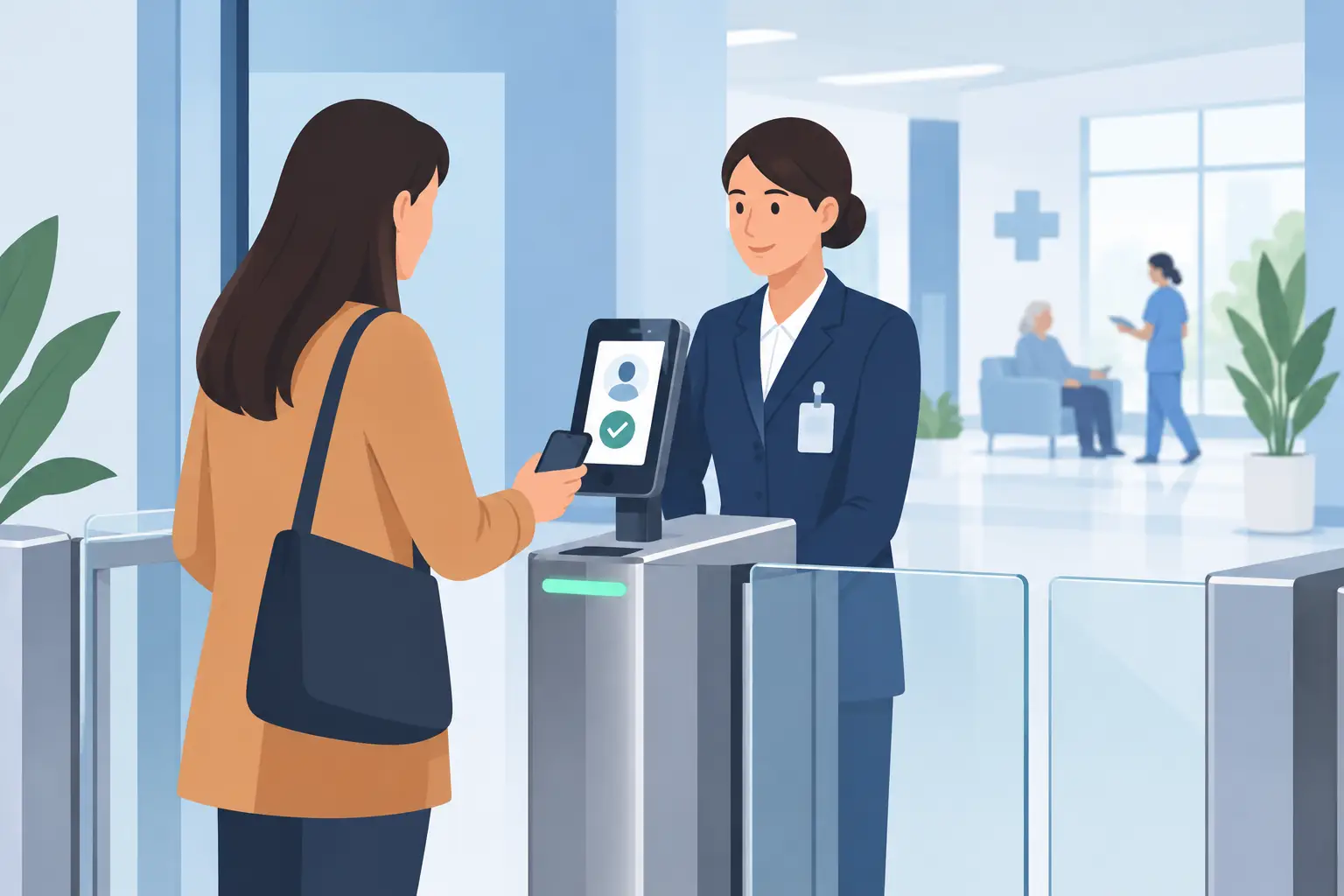
The reception desk remains central to visitor management, even where electronic access is installed. A good system supports reception staff rather than replacing them. Visitors can be asked to sign in, state whom they are visiting, confirm their identity where required, and receive a temporary pass or credential with the appropriate permissions.
For many sites, a printed badge is sufficient for visual identification in public and low-risk areas. For more sensitive facilities, a temporary proximity card, mobile credential, or PIN-enabled pass can release selected doors for a defined period. Once visiting hours end, the access automatically expires rather than relying on someone to collect every pass.
Clear instructions matter as much as the credential itself. Signs should direct visitors to reception, explain where passes are required, and make it easy to request help. This reduces tailgating, where an unauthorized person follows someone through a controlled door, often because they are unsure where to go or assume the door is open to everyone.
Use the Right Technology for Each Area
There is no single device that suits every healthcare entrance. The right choice depends on the door type, traffic level, security risk, fire safety requirements, and how the space is used.
For staff and managed visitor doors, card or fob readers offer a familiar and dependable method of control. Systems such as Paxton access control can be configured with individual permissions, time schedules, and event reporting. They are especially useful where managers need to add, remove, or change access rights without issuing new keys every time responsibilities change.
Video intercoms are valuable at entrances that should remain locked, such as staff parking gates, delivery doors, care-home entrances, and specialist units. Reception staff can see and speak to a visitor before granting entry. Where appropriate, video can also help staff manage deliveries and out-of-hours arrivals without leaving a secure desk.
Some areas need an additional level of assurance. A PIN, second credential, or biometric solution may be considered for high-risk rooms. However, more complex authentication is not automatically better. It can slow staff at critical moments, create hygiene considerations, and increase support requirements. The level of control should be proportionate to the room and the people using it.
Electronic locks, door closers, emergency break-glass units, and fire alarm interfaces must be specified and installed correctly. Security should never compromise safe emergency egress. This is one reason healthcare access systems should be planned by experienced professionals rather than treated as a simple door hardware upgrade.
Connect Access Control With CCTV and Alarms
A door event becomes much more useful when it can be reviewed alongside video footage. CCTV covering key approaches, entrances, reception areas, and access-controlled doors can help security teams investigate incidents, confirm visitor movement, and identify repeated access issues.
For example, if a door is held open after a visitor enters a ward, access logs can show when it happened while CCTV provides visual context. If an unauthorized person tries a locked entrance repeatedly, the system can support a quick, proportionate response.
Integration should be planned carefully. The goal is not to monitor every person unnecessarily. It is to provide meaningful evidence and faster situational awareness where risk is highest. Camera placement, recording retention, access to footage, and privacy policies should be agreed with the organization’s leadership and compliance teams.
Intruder alarms also have a role, particularly in areas that are closed overnight. A medication store, records room, or administrative office may need different alarm settings from a continuously occupied ward. Access permissions and alarm procedures should work together so authorized staff can enter safely without generating avoidable false alarms.
Plan for Real-World Exceptions
Healthcare does not operate on a fixed schedule. Visiting policies may change during an outbreak, a patient may require an approved family member outside normal hours, or an emergency department may need to manage a sudden increase in people at the door. The system should be flexible enough to support these situations without abandoning control.
Managers should be able to adjust schedules, create temporary credentials, and revoke access promptly if a pass is lost or a visitor’s circumstances change. Staff must know who has authority to make these changes, particularly overnight and at weekends.
Accessibility also needs early consideration. Readers, intercoms, gates, and reception procedures should be practical for people with mobility, hearing, vision, or language needs. A controlled entrance that cannot be used independently by part of the community creates a different kind of risk.
Maintenance Protects the Investment
An access control system is only dependable when doors, locks, readers, power supplies, and software are maintained. A damaged card reader, weak door closer, failing backup battery, or poorly aligned lock can undermine the entire arrangement.
Regular testing should include emergency release operation, door closing and locking, intercom audio and video, credential permissions, audit reports, and backup power. Permissions should also be reviewed routinely. Former employees, completed contractors, and expired visitor groups should not remain active by default.
For healthcare facilities in Gloucestershire, JP Security can assess existing doors and security systems, identify practical gaps, and design an integrated solution around the way the site actually operates. Whether the requirement is a controlled staff entrance, a video intercom at reception, CCTV at key access points, or a wider Paxton upgrade, professional installation helps ensure every component works together.
The right visitor access system should let approved people feel supported from the moment they arrive, while giving staff confidence that sensitive areas remain protected. Speak to an expert before a security concern becomes an incident.

