
 Blog
A powered gate or vehicle barrier should make access easier without creating a risk for the people, vehicles, and deliveries passing through it. For barrier and gate automation safety equipment in Cheltenham and Gloucestershire, the right solution begins with the site itself: who uses the entrance, how often it operates, where pedestrians walk, and what could happen if an obstruction is missed.
At a private driveway, that may mean protecting children, visitors, pets, and vehicles. At an industrial yard, retail parking area, healthcare facility, or managed residential development, the risks are broader. Staff may arrive on foot, delivery drivers may be unfamiliar with the layout, and vehicles may queue close to a moving barrier. Safety equipment is not an optional extra added after installation. It is a central part of designing a reliable automated entrance.
Why Gate and Barrier Automation Safety Matters
An automated gate has significant weight and moving force. A sliding gate can trap someone against a post, fence, or parked vehicle. A swinging gate can strike a person or vehicle within its travel area. A rising barrier can descend onto a vehicle, while a poorly planned barrier lane can encourage pedestrians to cross where they should not.
The practical question is not simply whether a gate opens and closes. It is whether it can recognize an obstruction, respond safely, and remain predictable when conditions change. Rain, leaves, ice, uneven ground, poor lighting, damaged equipment, and increased traffic can all affect how an entrance performs.
A professional survey identifies the hazard points before the system is selected. That includes the gate’s movement path, pinch points, visibility from the road, pedestrian routes, emergency access, and the likely behavior of users. A homeowner may need a discreet system that keeps a driveway secure while allowing family members to enter easily. A facilities manager may need controlled access for hundreds of staff, visitors, and delivery vehicles each week.
Safety Equipment for Automated Gates
There is no single safety device that suits every entrance. Effective protection usually combines physical safeguards, detection technology, correctly configured controls, and regular testing.
Photocells and Safety Beams
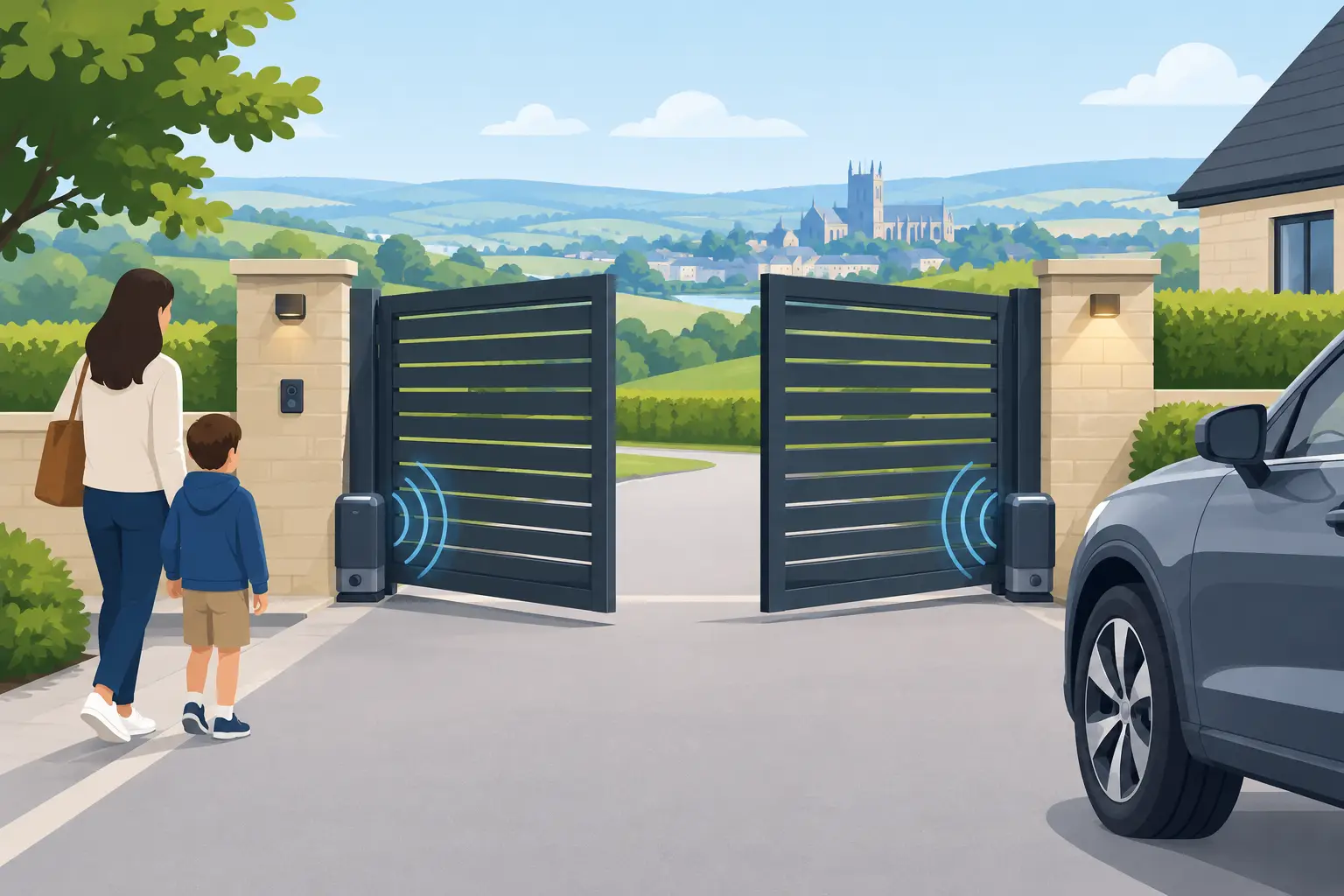
Photocells create an invisible beam across an entrance. If a person, vehicle, or object interrupts the beam while the gate is closing, the system can stop or reverse. They are particularly useful at driveways and vehicle entrances where the risk of a gate closing onto a car needs to be reduced.
However, one pair of photocells may not protect every risk area. A wide entrance, a sloping driveway, or a gate with complex movement may require multiple beams at different positions. They must also be installed where they remain effective, rather than where they are simply convenient to fit. Misalignment, dirt, spider webs, and physical damage can affect performance, so inspection is essential.
Safety Edges
Safety edges are pressure-sensitive strips fitted to the leading edge of a moving gate and, where required, other hazardous edges. If the edge contacts an obstruction, it signals the operator to stop and reverse or stop safely.
They are valuable where a gate can create a crushing or trapping point that a photocell cannot adequately protect. For example, a sliding gate may need protection at its closing edge and around areas where the gate passes close to fixed posts or walls. The exact placement depends on the gate design and the surrounding structure.
Force Limitation and Correct Operator Setup
Modern gate operators can be configured to monitor resistance and limit the force applied during movement. This provides another layer of protection, but it should not be treated as a substitute for properly placed safety devices. Force settings must be tested and adjusted as part of commissioning, taking account of the gate’s weight, track condition, hinges, and normal operating environment.
A gate that has become harder to move due to worn rollers, a damaged track, or poor hinge alignment may behave differently from the day it was installed. That is one reason routine servicing matters. Mechanical condition and electronic safety are closely connected.
Induction Loops and Vehicle Detection
For car parks, commercial yards, and barrier-controlled entrances, induction loops can detect vehicles in a defined area. They can prevent a barrier from closing while a vehicle remains beneath it or trigger an exit barrier for authorized traffic flow.
Loop placement needs careful planning. A loop that is too close to the barrier may not provide enough protection for longer vehicles. A system also needs to account for motorcycles, delivery vans, tailgating, and vehicles stopping unexpectedly. In high-use areas, combining loop detection with photocells and clear lane markings provides better protection than relying on one device alone.
Emergency Stops, Manual Release, and Clear Controls
Every automated entrance should have a safe method of stopping operation and releasing the gate manually when needed. This is especially important during a power outage, fault, or emergency. Authorized users should know where the release mechanism is and how it operates, while the equipment itself must be protected from misuse.
Controls should be positioned thoughtfully. A keypad, proximity reader, intercom, or remote-control receiver must allow users to operate the entrance without placing themselves in a danger area. On sites with visitor traffic, a video or audio intercom can help staff or residents verify a caller before granting access.
Barrier Safety for Busy Sites
A rising barrier is often the right choice for a car park or controlled vehicle lane because it opens quickly and provides a clear visual boundary. But barriers work best when the lane is designed around them. Pedestrians should have a separate, obvious route rather than being expected to pass around or under the barrier arm.
At offices, healthcare settings, retail sites, and industrial premises, access control can add another level of management. Authorized vehicles may use fobs, tags, keypads, or staffed intercoms, while visitor access can be reviewed before entry is granted. A barrier can also be integrated with CCTV, allowing incidents, misuse, or vehicle movements to be reviewed when necessary.
Visibility is equally important. Reflective markings, warning signs, lighting, and clearly defined stopping positions help drivers understand where to wait. This is not just about protecting equipment. It helps prevent rushed decisions at a point where vehicles, pedestrians, and moving machinery meet.
Maintenance Is Part of the Safety System
Safety equipment cannot be installed and then forgotten. Gates and barriers are exposed to weather, impact, daily use, and gradual mechanical wear. A system may still appear to operate normally even when a photocell is misaligned, a safety edge is damaged, or the closing force has changed.
Planned maintenance gives an experienced technician the opportunity to test safety devices, inspect cables and control panels, check hinges, rollers, tracks, and barrier mechanisms, and identify faults before they cause disruption or create a risk. It is also a sensible time to review whether the entrance still suits the site. A previously quiet driveway may now have more vehicles, or a business may have changed its traffic flow and visitor procedures.
If an existing gate or barrier behaves unpredictably, stops halfway, closes too forcefully, or has damaged safety devices, it should be assessed promptly. Continuing to use a faulty automated entrance can expose people and property to unnecessary risk.
Choosing the Right Local Installer
The safest system is a tailored one, not a standard package selected without a site visit. An experienced installer should assess the gate or barrier type, identify hazards, recommend suitable safety measures, and explain how users should operate the system. They should also be able to repair and upgrade established equipment where a full replacement is not necessary.
JP Security brings 37 years of security experience to homes and businesses across Cheltenham, Gloucester, Tewkesbury, and the wider Gloucestershire area. From automated driveway gates to managed car park barriers, the focus is on equipment that protects people while giving you practical control over who enters your property.
A safe entrance should feel straightforward to use: vehicles move when they are authorized, visitors know where to go, and the system responds properly when something is in its path. Speaking to an expert before fitting, upgrading, or repairing your gate or barrier can help ensure that convenience never comes at the expense of safety.
